Uncategorized

  • ‘I’d Rather Be a Prostitute than a Teacher’

    ‘I’d Rather Be a Prostitute than a Teacher’

    Font size: Decrease font Enlarge font
    image screenshot of the blog of the Hangzhou female teacher

    Can you believe those are the words of a high school teacher?

    In China’s traditional culture, intellectuals had upheld social mores. This trend seems to be reversing. With the coming of annual Teacher’s Day, a female Hangzhou teacher wrote, ‘I’d rather be a prostitute than a teacher’ in her blog. The current status of China’s educational system, moral values, the quality of teachers and their relative low living standards are concerning. It worries everyone who is concerned with the future of education in China.

    This teacher, claiming to have double degrees from a prestigious university wrote, “I’d rather be a prostitute than a teacher. I know many people will condemn me for my words. I do not know how students will react. Forgive me. The saying ‘Genius is 1% inspiration and 99% perspiration’ is only for fairy tales. A good life doesn’t depend on others, but is about how
    well you can sell yourself.”

    She describes her life: “I receive just about RMB2000 (USD300) a month as a lecturer. I live in a rented room, which can only accommodate a bed and a table. I have to be very careful with my expenses. In order to save 1 RMB a day on electricity, I have to live without an air conditioner and switch off the fan, even though I am sweating profusely.”

    Another woman, Mrs. Wang, is a retired teacher in Beijing whose husband is a professor at Peking University. As a young researcher he went through many trials after others stole his research results. His wife agrees with her husband’s words, “Choosing to be a teacher is choosing to be poor.” Many teachers struggle in today’s cash-driven society to comply with their professional code of conduct. According to Mrs. Wang, “In the pursuit of money many teachers just want to make extra income by tutoring. This reflects on the students and parents. Students do not learn important things these days. In the past teachers were regarded as ‘gardeners for the future flowers of the country.’ They are like doctors looking after the souls of the next generation, but present-day ethics seems to be far removed from that.”

    Although money is necessary, if values are measured solely in monetary terms, what will society’s future be?

    Hu Ping, Beijing’s Spring Magazine’s editor-in-chief, thinks Chinese society now laughs at poverty but not at prostitution, and values are reversed, which affects the perceptions people have of teachers. “In the Chinese tradition, teaching is a very respectable career, but now it has a poor reputation. One reason for its poor reputation is certainly related to wages; the other is that teachers face tough choices in today’s China making it difficult to assume the role of educators for the community. Just like other industries, the educational field has its shortfalls making it challenging for teachers to feel like an honorable person in such an environment.”

    Prof. Zhang Tianliang from George Mason University commented how in the past the teacher’s job was not only to teach skills but also how to handle life. It was important to teach them how to be good people. Now teachers just pass on science and technical knowledge to the next generation, without addressing moral values. This leads to a fast decline in human morality. The teachers can no longer win students’ respect if they take this approach either. “The CCP (Chinese Communist Party) itself is a criminal group oozing corruption. Students’ minds are actually instilled with this ideology, so the current generation has been disjointed from traditional culture.”

    A teacher commented on a blog, “Chinese society and its educational system make teachers’ morals unsustainable. Dutiful teachers feel humbled when facing rude students and low wages, and even more so when their own children look down on their careers.”

    http://en.kanzhongguo.com/realchina/i_d_rather_be_a_prostitute_than_a_teacher.html


  • 自曝“五毛”培训视频 湖北

    大陆电视台播出的湖北浠水县宣传部培训网络评论员的录像,揭开了“五毛”的面具。(视频截图)

    自曝“五毛”培训视频 湖北官方急删 [Chinese TV News Reveals Regime’s Internet Commentator Training]

     
    【大纪元2011年09月13日讯】(大纪元记者陈怡莲报导)一直以来,中共官方都在不公开地雇用大批被网民称为“五毛党”的“网络评论员”,帮其操控网络舆情。最近,一段在大陆电视台播出的湖北浠水县宣传部怎样培训网络评论员的录像,揭开了“五毛”神秘的面纱。该培训中要求“五毛”对突发公共事件,应快报事实,慎报原因,“正确引导舆论”。并说,互联网已成为“意识形态较量的重要战场”。该视频放在网路上不久就立刻被删除。有评论说,这不是正常的文宣,完全是一种欺骗。

    中共视互联网为“意识形态较量的重要战场”

    9 月8日,浠水县委宣传部组织各单位新闻发言人和全县网评员进行业务培训,要求提高“维护党和政府形象”的能力,提高“处理突发事件”的能力,提高“引导舆论和公关”的能力,提高“运用和管理互联网”的能力。并强调,尤其是互联网已经成为覆盖广泛、传播快捷、影响突出、发展强劲的大众传媒,成为“意识形态较量的重要战场”。

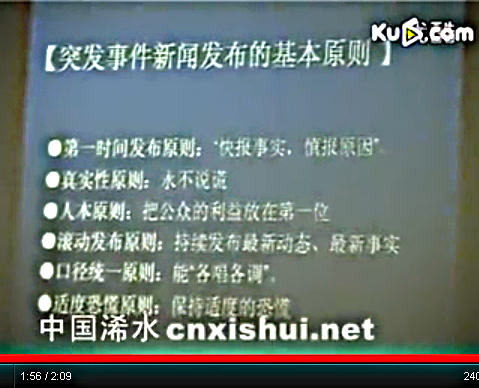
    在录像中可看到,对于突发事件新闻发布的基本原则要求是:快报事实,慎报原因;口径统一,能“各唱个词”;保持适度的恐慌。

    网友“一生的唯一”说:“五毛开会的视频终于曝光了。通过关系都找不到的这种视频居然在电视台播放了,只能说这个宣传部长真是一个彻底的傻呀。”


    培训中要求“五毛”对突发公共事件,应快报事实,慎报原因,“正确引导舆论”。(视频截图)

    “不是正常的文宣 完全是一种欺骗”

    诗人何军樵对大纪元记者表示,对思想领域的管理,中共是有历史传统的。从它起家开始,就非常注重思想领域里面的宣传、控制、渗透等一些工作,一直都没有变过。同时中共也是靠这一手起家的,这是它能存在到今天的很重要的一环。所以它这个宣传部都是很高级别的,其部长都是常委级的。

    他说,在这种教育下的国民已经没有太多自己的思考能力了。他们认为这是统治人民的一种有效的方法,所以中共政府才会下这种功夫。换成世界上任何一个正派的政府,一个正常运作的政府,他都绝对不可能拿纳税人的钱去做这种匪夷所思的事情。

    “但是专制政府会做,只要对他有一点好处,因为它的核心利益就是维护它的统治。这种思想方面的挑战也是很可怕的,它能让人民丧失判断能力。我们知道政党都会有自己的文宣,这个是很正常的事情,但这种不是正常的文宣,这完全就是一种欺骗。”

    六四天网创始人黄琦先生表示,在当今中国大陆,随着民间维权运动的崛起,用互联网传递民主资讯已使公安的网络管制失效,才会出现现在这种大面积的培训“五毛”、使用“五毛”的局面。

    “当我们看到培训‘五毛’已经到达县镇乡一级时,说明中国的民主化进程基本上已经发展得很好了。‘五毛’对中国民众的影响是随着时间的推移越来越下降。因为他们是一帮雇佣军,属拿钱替人消灾的这种人,所作的效果也不会好的。”

    中文独立笔会成员簪爱宗认为,“五毛”在互联网上的做用已经越来越小了,只是在滥竽充数。“据我所知这些人在网上发言论,也不是发自内心的,只是为了一点利而已。”

    “我认为他们现在只是在自娱自乐,掩耳盗铃,他们的这些伎俩大家都已经看穿了。看他们还能维持多久?就像红卫兵已经成为历史、红歌唱几天就没有人听了、厌烦了一样,过一阵子就不会有什么市场了。”

    中共目的就是为了搅混水 掩盖真相

    中共当局通常雇佣“五毛”以普通网人的身份,发表尽可能对中共官方有利的评论,来试图达到影响网络舆论的目的。他们有组织地攻击知名敢言的网络名人,在各大政治论坛猛打嘴炮,造成论坛混乱甚至被查封;在自己的博客中写文大肆拥护共产主义;歌颂文化大革命、歌颂毛泽东等等。

    当被民众讥讽他们为发一篇网络评论能赚5毛钱的“五毛党”时,五毛党也反诬揭露他们的网民为“美分党”。不过迄今为止没有任何来自“外国反华势力”的公开资料能证明“美分党”的存在,不过五毛党培训视频却被公开了。

    通过不时曝光的“五毛内部工作指南”,可以看到五毛的搅乱视听的手法,比如有指南中写:“某些谣言出来的时候,必须尽快搜索到谣言的首发地点和首发人,然后勒令网站管理员删除原帖,网络评论员则拷贝内容,以不同的IP地址发表自己就是事发所在地的当地人的申明,然后以版主或以其他网友身份指出:他的IP地址不在事发所在地,该消息纯属谣传。”这样使民众难以获知真相,在真相面前也难以分辨。

    还有网民以“这鸡蛋真难吃”为题,列出五毛的十几种搅混水的手法。

    五毛会以下手法发表评论搅混水:
    1、隔壁的鸡给了你多少钱?
    2、有本事你下个好吃的蛋来。
    3、下蛋的是一只勤劳勇敢善良正直的鸡。
    4、再难吃也是自己家的鸡下的蛋,凭这个就不能说难吃。
    5、比前年的蛋已经进步很多了。
    6、你就是吃这鸡蛋长大的,你有什么权力说这蛋不好吃?
    7、你这么说是什么居心什么目的?
    8、自己家鸡下的蛋都说不好吃,你还是不是人!
    9、隔壁家那鸭蛋更难吃,你咋不说呢?
    10、嫌难吃就别吃,滚去吃隔壁的鸭蛋吧。
    11、鸭蛋是好吃 ,可是不符合我们家的具体情况。
    12、胡说!我们家的鸡蛋比邻居家的鸭蛋好吃五倍!
    13、凡事都有个过程 现在还不是吃鸭蛋的时候。
    14、光抱怨有什么用,有这个时间还不如努力去赚钱!
    15、心理阴暗,连鸡蛋不好吃也要发牢骚。
    16、世界上没有绝对的好蛋,美国鸡蛋好吃,你去吧!
    17、吃鸡蛋的也不是好鸟,吃了鸡蛋还留下证据说鸡蛋难吃,太有城府了

    随着有正义感的网民对五毛党的揭露,五毛的日子也不好过了。北京律师、办有“后改革思想网”的陈永苗曾向自由亚洲记者表示,五毛党影响网络舆情的作用其实很小,“因为它一整套的话语没有太大的说服力。对于普通网民来说并没有说服力,因为目前普通的网民遭受的社会经济条件的恶化,对一般人而言,可能基本上不会被‘五毛党’说动。”

    (责任编辑:徐亦扬)

    http://www.epochtimes.com/gb/11/9/13/n3371428.htm

    Chinese TV News Reveals Regime’s Internet Commentator Training

    By Chen Yilian
    Epoch Times Staff
    Created: Sep 19, 2011 Last Updated: Sep 19, 2011
    Print | E-mail to a friend | Give feedback
    Related articles: China > Regime

    A TV broadcast in mainland China unexpectedly revealed how the Propaganda Department trains Internet commentators to shape public opinion. (TV screen shot/Epoch Times)
    A Chinese TV news report unwittingly revealed how the communist regime’s Propaganda Department trains its army of paid Internet commentators, notoriously known as “50-cent-party,” to shape public opinion on the Internet.

    On Sept. 8, Xishui TV, a local station in Hubei Province, reported a training conducted by the Xishui County Propaganda Department for spokespersons from various work units and all Internet commentators in the county. The purpose of the training, according to the report, was to continuously improve the skills of spokespersons and Internet commentators and to enable them to respond to a public crisis as well as guide public opinion in a “constructive way.”

    A delegate of the county’s standing committee, who is also the director of the Propaganda Department, said in the opening that the Internet has already become a public media that spreads information widely and quickly; it also has strong impact and will continue to evolve in the future, therefore making it “an important battlefield of ideology.”

    Faced with the diversity and complexity of needing to create press releases and guiding public opinion via the Internet, the report said, the training required that everyone develop and improve their professional skills in the following areas: safeguarding the image of the Party and the government, handling sudden breaking news, guiding public opinion and performing public relations, utilizing and managing of the Internet.

    It encouraged participants to “become a press spokesperson of high caliber, who can guide public opinion in the right direction and make contributions to local harmony and stability.”

    The training also provided know-how on creating press releases, guiding public opinion, improving communication skill with the media, and handling breaking news in a “positive” way.

    “Report the facts quickly, but report the causes cautiously; report with unanimous voice, while using your own words; maintain a proper level of panic,” were the basic principles given for writing media releases on sudden breaking news.

    Distorted People’s Conscience

    Who the “50-cent-party” members are, and how they go about their business, has been a mystery to most Chinese bloggers who have been the victims of Internet censorship for a long time.

    The video was originally posted on cnxishui.net, which is operated by Xishui County Propaganda Department, and must have been an accident as it was removed just a few hours after its appearance. But it was long enough for many Chinese netizens to become aware and comment on it.

    According to a report by Hong Kong’s Apple Daily, Internet commentators in the early days ran their operations in secret and seldom revealed their identities. In recent years, however, Beijing has escalated efforts in training and promoting them, and has allowed them to make public appearances in the media to boast about their “achievements.”

    One blogger used plain language to express his sense of disdain over the training video’s blatant showoff posting, saying: “Such a video clip, that cannot be obtained even by pulling strings, was actually aired on TV! It only proves that the propaganda minister is a complete idiot.”

    In mainland China, not only provinces and municipalities hire Internet commentators, but counties also set up training for Internet commentators. [ Chinese articles: 1 | 2 | 3 | 4 ]

    The Apple Daily report said that with the Chinese Communist Party (CCP) as their backing, the number of Internet commentators in China is estimated to have reached 280,000. With each one of them posting five comments per day, that amounts to 1.4 million posts daily, enough to inundate some Internet forums and ensure “harmony” for the CCP.

    Heng He, a commentator at New Tang Dynasty TV, said the CCP has distorted people’s conscience by manipulating Internet commentators to serve it.

    Heng compared the CCP with the former East German state where informers for the communist authorities used to operate in secret and were kept away from public view.

    “But under CCP rule, these kind of people have gained recognition from society, and people are encouraged to do so, and do it openly,” Heng said.

    Chinese Poet He Junqiao told The Epoch Times that the CCP has always paid great attention to propaganda, control, and the spreading of ideology. Propaganda departments are usually under the control of high ranking officials who are members of the Standing Committee, he said.

    “It is quite normal for a political party to have its own propaganda, but this is not normal propaganda, and is nothing but complete deception,” He said.

    Read the original Chinese article.

    chinareports@epochtimes.com


  • King Wen of the Zhou Kingdom Rules by Virtue

    King Wen of the Zhou Kingdom Rules by Virtue

    By Stephen Gregory & David Wu
    Epoch Times Staff
    Created: Sep 18, 2011 Last Updated: Sep 18, 2011
    Print | E-mail to a friend | Give feedback
    Related articles: China > Culture

    King Wen ruled the Zhou kingdom by virtue. (Blue Hsiao/Epoch Times staff)

    King Wen of the Zhou kingdom (BC 1152 – BC 1056) from the Shang Dynasty was known for ruling by means of virtue and kindness. He taught people to be honest, respectful to God, and virtuous. He often said: “The king shall rule people with benevolence; officials shall manage people with care; children shall respect parents with filial piety; parents shall raise children with love; and the people shall associate with one another in good faith.”

    King Wen was very meticulous, cautious, and conscientious. He put himself forward as an example for people. He wore simple clothes and often worked together with farmers in the fields.

    His first thought was for the good of the people. He cut taxes for farmers and encouraged farmers to farm public fields by charging them a tax of only one-ninth. With all these preferential measures, the farmers could save money. In addition, King Wen eliminated tariffs for import/export transactions and abolished the law requiring wives and children to be punished for the crimes committed by their husbands or fathers. King Wen provided the poor with prompt help and care.

    Once, two kings who were arguing with each other about a boundary went to the Zhou kingdom to seek a judgment from King Wen. As soon as they entered the Zhou kingdom they observed how the people were very polite, peaceful, and courteous. Being touched by what they saw, both kings stopped arguing and wanted to let the other king have the disputed land.

    Dukes near the Zhou kingdom heard about the matter and respected King Wen as a model for how to rule. All of them came to Zhou to promise to obey Wen and become part of the Zhou kingdom.

    King Wen knew a state would not run well without virtuous persons to assist him. When King Wen heard Jiang Ziya was a very virtuous sage with very profound knowledge, he visited Jiang Ziya and asked him to be his advisor in how to rule a state. Jiang Ziya assisted first King Wen and later King Wu of the Zhou kingdom.

    The way that King Wen ruled the kingdom laid a good foundation for future generations for the good rule of the united nation.


  • Nine ‘Independent Candidates’ Arrested in Beijing

    Nine ‘Independent Candidates’ Arrested in Beijing

    By Chen Yilian
    Epoch Times Staff
    Created: Sep 19, 2011 Last Updated: Sep 19, 2011
    Print | E-mail to a friend | Give feedback
    Related articles: China > Society

    Through arrests and a concerted media blackout, Chinese authorities are attempting to stop citizens from participating in local legislatures across China.

    In the latest incident, 9 of Beijing’s 13 citizen candidates were arrested in the home of one activist on Sept. 16. Two journalists from a British newspaper caught in the drag net.

    Called “independent candidates,” the individuals will run for seats in local versions of the National People’s Congress, China’s faux-legislature, across the country. The elections will take place before the year’s end.

    Although being an “independent candidate” is ostensibly legal in China, it’s difficult to pull off: historically the positions have been filled by Communist Party confederates.

    After candidates declare their intention to run, each needs to enlist 10 people to jointly nominate the person.

    But those who have gotten that far usually begin getting harassed and intimidated, to discourage them from running.

    Candidates so far have had to use Sina Weibo (a restricted Chinese version of Twitter) to make public their intention to run for election because the media have been forbidden to report on them.

    These independent candidates are usually activists who have fought for the protection of their legal rights, and they hope to use such experiences to help other vulnerable groups.

    The latest arrest included Ye Jingchun, Yang Lingyun, Zhang Shangen, and Zheng Wei. The group had gathered in Zheng Wei’s home in Jingshan, Dongcheng District, on Sept. 16. Othersarrested at the same time included a candidate sponsor, He Depu, and two reporters from Britain’s “The Guardian.”

    When The Epoch Times called the Jingshan Police Station to ask about the arrests, an officer said that the station wasn’t taking calls from the media and hung up.

    One candidate from Haidian district, Han Ying, told The Epoch Times that some of the arrested candidates were later moved, but none released.

    She believes that, despite the harassment, the candidates won’t be deterred. “We have just started our planning, yet the authorities are already using these methods to pressure us to stop. It is unbelievable. Thepolice are the ones violating the constitution. They simply do not want people in the election; we are now questioning whether the current representatives were elected by the citizens,” she said.

    Zhan Jiang, a candidate from Haidian district in Beijing, is braced for the battle: “We’ll still participate… The pressure in Guangdong Province is also very heavy. We expect even more attention will put on the election in Beijing.”

    chinareports@epochtimes.com

    http://www.theepochtimes.com/n2/china-news/nine-independent-candidates-arrested-in-beijing-61784.html


  • To Help or Not to Help, a Dilemma in China

    To Help or Not to Help, a Dilemma in China

    Moral decay seen as cause of problem

    By Feng Yiran
    Epoch Times Staff
    Created: Sep 18, 2011 Last Updated: Sep 18, 2011
    Print | E-mail to a friend | Give feedback
    Related articles: China > Society

    An elderly woman rests beside a pedestrian overpass in Beijing.
    An elderly woman rests beside a pedestrian overpass in Beijing. (Frederic J.Brown/AFP/Getty Images)
    Recent guidelines by Chinese authorities on how to assist an elderly person who has fallen in the street, have unleashed a debate among Chinese netizens. They are in a catch-22 between wanting to help, and a fear of being sued by predatory elderly fall victims. The government guidelines have piled insult upon injury, according to some netizens.

    Falling down is a leading cause of death for Chinese citizens aged 65 and above, according to Yang Maowei, Associate Professor of the First Hospital of China Medical University. However, in recent years, there have been frequent reports of such deaths in public places with no one helping the victims, Yang said.

    It seems that Chinese people have become reluctant to help because they worry that the person they help may later turn around and sue them, as that is what’s been happening a number of times in recent years. As a consequence, several elderly have been left to die in the streets with people passing by or watching, but not helping them.

    On Dec. 29, 2010 an 83-year-old retired veteran, Mr. Zheng, fell while walking on a sidewalk in Fuzhou City of southeast China’s Fujian Province. A handfull of people stopped and looked on, but no one helped him. When the ambulance arrived, the man had already stopped breathing, Southeast Express reported.

    Another similar case happened on Dec. 14, 2010 in a community of Shenzhen City when 78-year-old Mr. Xiao Yusheng fell and was left lying on the ground until his son found him 20 minutes later. None of the passersby tried to help, according to a report by Southern Metropolis Daily.

    Most recently, an 88-year-old man, Mr. Li, fell on Sept. 2 in front of a market in Wuhan, less than 100 meters from his home. He tried to get up, but didn’t have the strength, Chu Tian Metropolis Daily reported on Sept. 4.

    A nearby vendor said that Mr. Li lay on the ground for one hour, with many people stopping to look at him, but no one helped him up. Eventually someone informed his family, and he was taken to a hospital, but he had already died of asphyxiation.

    Mr. Li’s 87-year-old wife, Zhou Juzhen, issued a statement three days later saying, “If I fall on the sidewalk, people who help me will not be held liable for any consequences.”

    Ms. Zhou said she wanted to remove people’s fear of negative consequences in case she ever needed help in an emergency situation.

    Fear of Helping

    Southern Metropolis Daily said in a Sept. 9 report The Fear of Helping the Elderly is the Real Sorrow, that the phenomenon reflects Chinese people’s mistrust of society. The report cited three cases of people being sued after helping an elderly.

    In 2006, Peng Yu, in Nanjing, Jiangsu Province, helped an old lady who had fallen and broken a bone. She subsequently sued Peng, and the case went through three trials before the parties reached an agreement and the woman withdrew the case.

    In another case in Tianjin in 2009, a Mrs. Wang fell down and was hurt when she illegally climbed over a roadside railing. Mr. Xu Yunhe, who happened to drive by, noticed her fall and stopped his car to help the old woman, bandaging her up and calling first-aid.

    Mrs. Wang, however, claimed that Xu’s car had bumped into her and sued Xu in court. The court ruled that Xu should pay 100,000 yuan (US$15,654) in compensation.

    On Aug. 26 of this year, Hong Bin, a bus driver, helped an old woman who had fallen in the street, but was accused of being the perpetrator. He was eventually exonerated through a monitoring video recording.

    These three cases have attracted nationwide attention, and are said to be the reason for Chinese people’s reluctance of helping the elderly in emergency situations.

    Ministry of Health Guidelines

    Now China’s Ministry of Health issued guidelines on Sept. 6 on how to handle cases of elderly falling. But instead of addressing the worrisome legal liability issue, they focus mainly on medical consequences of a fall and offers technical solutions to different fall scenarios, while also telling people to overcome embarrassment and psychological fear of helping.

    This has further inflamed citizens who feel in a catch 22 between wanting to help, and having fear of being taken advantage of for their kindness.

    One line in the guidelines that particularly irked netizens said, “whether or not to lend a hand depends on the situation.”

    After the Ministry’s guidelines came out, Sina Weibo conducted a poll, asking people whether they are still willing to help an elderly who has fallen, considering the Ministry’s guidelines.

    Of the 5,031 who voted, only 20 percent said yes, while 43 percent said no, and the remaining 38 percent said, they’re not sure.

    Some people left comments expressing their inner conflicts and disillusionment over China’s sliding moral values:

    “I dare not help, but I’ll run to a public phone booth to call 120, [the emergency number in China], and ask for an ambulance.”

    “I can’t even protect my own safety. How can I have the ability to take care of others? It’s really funny!”

    “To put it frankly, it reflects the degeneration of society’s morality. The culture has no direction, the morality has no bottom line, and the trust between people, and between people and the government is too low.”

    “Unless I were Bill Gates, I would help for sure.”

    “I would certainly help before. Now I’m really a bit afraid.”

    “In today’s Chinese society, traditional values and virtues have been eradicated completely. No matter what guidelines are issued, when one really stands at a critical point, the law will not protect the poor people.”

    “There’s no way out. The state educates us this way, and now it turns around to accuse us of having no morality. Isn’t that ridiculous? Whether to help is not a moral issue, but the crux of China’s current education.”

    “At present, China’s social values are lost and morality is ruined to the point of national doom.”


    Read the original Chinese article

    chinareports@epochtimes.com


    http://www.theepochtimes.com/n2/china-news/to-help-or-not-to-help-a-dilemma-in-china-61733.html


  • Chinese Lawyer Reveals Brutalities in Custody

    Chinese Lawyer Reveals Brutalities in Custody

    By Gu Qing’er
    Epoch Times Staff
    Created: Sep 19, 2011 Last Updated: Sep 19, 2011
    Print | E-mail to a friend | Give feedback
    Related articles: China > Democracy and Human Rights

    Beijing human rights lawyer Jiang Tianyong. (Epoch Times)

    Chinese human rights attorney Jiang Tianyong, who was arrested in February as part of the Chinese Communist Party’s attempt to nip a homegrown “Jasmine Revolution” in the bud, recently broke his silence about what went on while he was in custody.

    Isolation, brainwashing, sleep deprivation and torture were regular parts of those two months. He had been arrested by police in front of his family members, who simply said that he was “under investigation.”

    He was released on April 29, but not until mid-September did Jiang tell his story. The most painful part of the ordeal was the brainwashing sessions, he told Sound of Hope Radio (SOH) on Sept. 14.

    “I was completely isolated from the outside world and had no opportunity to obtain information other than that forced on me by the police during the brainwashing sessions. In fact, I was under slow mental death. You know, in ancient China, there was a form of execution named slow slicing or lingering death [lingchi].”

    During the two months of detention neither Jiang nor his family received an official notice or documentation; no one on the outside knew whether he was dead or alive. Jiang, a lawyer since 2005, became a target because of his willingness to take on human rights cases. In particular, he defended practitioners of Falun Gong, a group that is persecuted without mercy by the regime.

    “I spent the entire detention period in one room, except that they moved me twice. I did not know where I was because when they moved me they covered my head,” he told Voice of America (VOA). “Day in and day out, I was under a blinding white light in that room. I do not know how I spent the spring; I didn’t see a single ray of sunshine.”

    Starting from the third day of the detention, Jiang was put under a strict schedule. He had to get up at a required time, then report to the police and shout slogans saying that he was willing to accept the government’s education. After that, he had to recite lyrics of three songs praising the Communist Party—making a mistake meant he had to start again.

    Jiang was interrogated from midnight to 5am for the first five nights of his detention.

    The mental torture and sleep deprivation contributed to his memory loss, Jiang told VOA. Jiang said that he used to have a very good memory, but noticed lately that he could not remember things, such as items in his bedroom and his Skype password. Jiang lost 18 pounds during the two months.

    He did not give in, though. “These horrible things happened to me. I must speak out and let everyone know,” he told SOH. “Sooner or later people will know, no matter how hard the CCP hides it. If the CCP does not want people to know, then they should not do it… the terror will be and must be broken.”

    On Sept. 1 Jiang and another Chinese rights lawyer, Teng Biao, were recognized for this year’s Prize for Outstanding Democracy Activist, given by the Los Angeles based Chinese Democracy Education Foundation (CDEF).

    Jiang was not permitted to travel to the U.S. for the award ceremony.

    Read the original Chinese article.


  • Five Elements and The Human Body

    Five Elements and The Human Body

    Font size: Decrease font Enlarge font
    image Chinese philosophy identifies 5 different ways that Qi manifests itself in the universe as the five elements.(screenshot)

    How five elements affect each other in our body?

    In Chinese medicine, a human body is divided into five systems, namely, wood, fire, earth, metal and water. Human organs and tissues correspond to the five elements. The body’s five systems not only automatically self-regulate according to the laws of yin and yang, but also co-ordinate with the five elements from the outside world at the same time in order to achieve health.

    In the outside world, people most likely react to a few things, such as climate, colour, sound and so on. Climate exhibits as spring, summer, autumn and winter; the colours present as red, yellow, white, black and green; in sounds, they are do, re, mi, sol and la.

    In fact, even moral and ethical elements correspond with the five elements. For example, benevolence is wood, righteousness is gold, propriety is water, wisdom is fire and trust is earth.

    There are five windows connecting with the outside world for the major systems in the human body. Traditional Chinese medicine calls these “apertures” or “mouths”, such as for the spleen, it is the mouth; for the lung, it is the nose; for the liver, it is the eyes; for the heart, it is the tongue; and for the kidneys, it is the ears. Human beings learn about the outside world through these orifices.

    Let’s look at the relationship between the five systems and the elements.

    Five elements:           earth, metal, wood, fire and water.
    Five orifices:             mouth, nose, eyes, tongue and ears.
    Five colors:               yellow, white, green red and black.
    Five notes:                do, re, mil, sol and la.
    Five inner organs:      spleen, lungs, liver, heart and kidneys.
    Five hollow organs:   stomach, large intestine, gall bladder, small intestine and bladder.
    Five principles:          trust, righteousness, propriety, wisdom and courtesy.

    The five colours, five notes and five principles exhibit from different perspectives, but they all convey the same thing. Only when the notes are pure can they inspire people to connect to the Tao and awaken people’s conscience.

    Then, how do the five elements affect each other? For example, “metal” is the daughter of “earth”, which has “fire” as its parent. Earth’s subjects are water and its official is wood. If all these were employed in a metaphorical relationship in human beings, it would look like this – a virtuous man is loving and kind to his children, honours his parents, cares about his subjects and is also a sincere and righteous official.

    Thus, it appears that every element is closely related to the other four elements. Therefore, when the ears, the orifice of the kidneys, hear wonderful music, the other four organs also benefit; when the eyes see something elegant, the other four organs share in beauty. When the inner meanings from the sounds and colours pass through the inner organs, they awaken our moral elements. In other words, it helps a person to follow the universal principles and behave like a righteous human being.

    http://en.kanzhongguo.com/health_science/five_elements_and_human_body.html


  • ‘인권상’ 수상하실 대통령께

    ‘인권상’ 수상하실 대통령께 누가 되는 인권탄압은 바로잡혀야******
    정희순
    2011.09.16 15:09:53
    조회수3,516    신고
    공감해요
    • 1,531 


    C<br />
					로그 미투데이 트위터
    Facebook
    var addthis_config = {“data_track_clickback”:true};
    오는 20일 이명박 대통령께서는
    미국, 뉴욕에서 ‘양심의 호소’라는 단체에서 수여하는
    민주주의와 인권에 기여한 공로로 ‘상’을 받으실 예정이다.

    대통령 님과 우리나라에 영광이지만
    현재 한국 내 인권상황은 이 상에 미치지 못한다.
    약 10일 전에 파룬궁 난민 판정이 기각된 한 중국동포가
    불법적인 절차로 단속반에 의해 구속 수감중이기 때문이다.

    중국에서는 파룬궁을 수련한다는 이유만으로 인권을 무지막지하게 탄압하는데,
    우리 정부는 이미 10명의 파룬궁 수련생을 인권의 사각지대, 중국으로 내몰았다.
    전 세계를 통틀어 러시아가 중국에 1명을 수 년전에 보낸 것을 제외하고는
    그 어느 나라도 파룬궁 수련생을 중국에 보내지 않는다.

    중국에 가면 파룬궁 수련생들은 모진 고문으로 목숨이 위태로움을 전 세계가 인정했는데
    유독 우리나라만 애써 중국의 인권탄압에 눈을 감는다.

    대통령 님께서 인권 상을 받으시기 전에
    한국 내 잘못된 인권상황은 반드시 바르게 잡혀야 한다.
    우리나라가 세계의 웃음거리가 되는 것은 우리국민 누구도 원하지 않는다.
    • 공감해요
    • 1,531 


    http://www.president.go.kr/kr/community/bbs/bbs_view.php?uno=418021&article_no=129584&tp=2&board_no=A01&search_key=&search_value=&search_cate_code=&order_key1=1&order_key2=1&cur_page_no=1


  • 网络流传的性笑话 真实现了

    网络流传的性笑话 真实现了!?

    ——县长让村长的笑话变成了现实


    打印版 阿波罗新闻网2011-09-16讯】
     

    网上流传着一个笑话,说:某村年轻人要外出打工,临行时,村长叮嘱说:“现在社会风气不好,不要在外嫖娼,一但染上性病,这个村就完了。”

    年轻人困惑,村长解释说:“得了性病就会传给你老婆,你老婆会传给我,我再传给全村的妇女。这村不就全完了吗!”没想到,这个笑话竟然成真。

    有媒体报导说,贵州三穗县落马的副县长杨昌明,感染了爱滋病。他承认,曾经与30多名女性发生关系,并染上多种性病。这些女性多为女干部和女教师。

    一时间,闹得全城人心惶惶。新浪博客,有篇署名廖小利的文章评论说:这件事儿,再次证明了官场的一个有趣现象,没有曝光的贪官都是好官。

    杨昌明事发前,尽管老百姓怨声载道,但在组织部门眼里,还是一个好官,很有魄力,因此,他的仕途一路顺风,层层提拔,最后坐上副县长的宝座。杨昌明一朝重权在握,很快成为一个财色兼收的腐败官。

    杨昌明是个财迷,什么钱都要,而且是主动伸手,只要经他签批的项目都要“孝敬”;杨昌明又是个“色迷”,什么女人都敢玩,从女干部、女教师到发廊妹,来者不拒。

    杨昌明东窗事发,本来是件很寻常的腐败案,却造成三穗全城的爱滋病恐慌,人人自危。

    哪些人跟杨发生过性关系?是否会被传染?让不少三穗人惶惶不安,据说,很多女干部都急着往医院跑。NTD 禁言


    一个县城如此,一个县如此,整个大陆,都如此?!学者警告如下:


    中共官场艾滋病 大陆学者:传染全大陆人灭顶之灾
    ——“日后提拔”变“日后遭殃” 中共的官场艾滋病

    作者:林原 大陆学者


    贵州省黔东南苗族侗族自治州三穗县副县长杨昌明在今年三月被「双规」,并接受检察机关调查。当地遍传杨昌明已染上艾滋病(按照检察院的说法是有「多种性病」),且他在任期间至少与三十多位女性发生过关系,其中多数为女干部和女教师。这些女性无论是被强奸还是被诱奸,或是主动投怀送抱,现在等待她们的已经不是官场潜规则中的「日后提拔」,也不是「日后再说」,而是「日后遭殃」了。

    估计中国大陆淫乱的官场得艾滋病的肯定不会只有杨昌明副县长一人,而他只是第一个被「遮遮掩掩」地揭露出来的,后面应该还有很多。但真相恐怕又会被这个黑暗的官场掩盖住,正如它以往掩盖过无数真相一样。

    有网友对「狗官」们得艾滋病幸灾乐祸,并表示愿意看到他们都患上这种病。但这些网友没有进一步去想:中国有几百万乃至上千万各种各样的男干部(在政府机关、事业单位、国有企业中工作),这些人除了能将艾滋病、性病等传染给各自的老婆、二奶、三奶等外,还会传染给女部下、男部下的老婆、来办事的女公民、关系企业的女员工还有宾馆女服务员等等。这样下去传染的规模会是相当可观的。

    苹果日报

    建议中国公务员们每三个月检查一次艾滋病、性病等,这当然是治标不治本的措施。在此还要提出更重要的建议:这个已得绝症的官场该考虑自己的「终场」了,不要让整个中国都传染上绝症。腐败官员们可以断子绝孙,中华民族不能。

    阿波罗网责任编辑:zhongkang         来源:

    本文网址:http://www.aboluowang.com/news/2011/0916/-133856.html


  • 《炎黄春秋》揭毛泽东《矛

    《炎黄春秋》揭毛泽东《矛盾论》涉抄袭