Uncategorized

  • 港府施「惡法」 圖拆除法輪

    港府施「惡法」 圖拆除法輪功真相展板 [Hong Kong Authorities Ban Falun Gong Roadside Display]
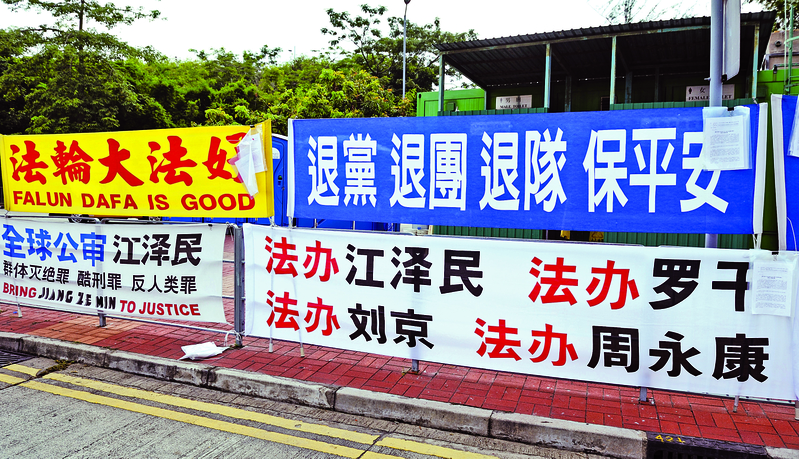
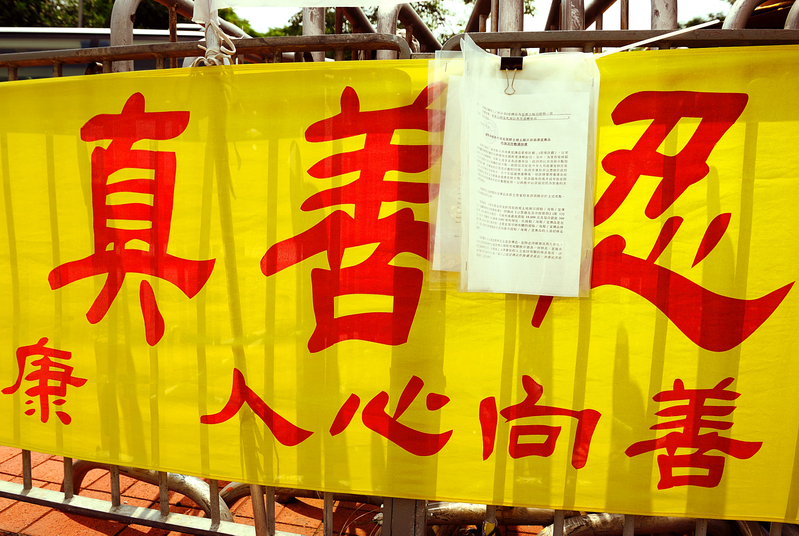
    香港法輪功的真相展板和橫幅(攝影:宋祥龍/大紀元)


    【大紀元2011年09月09日訊】(大紀元記者李真、林怡香港報導)香港政府近期除了對新聞採訪、市民表逹政治訴求打壓外,更以所謂交通市容、區議會選舉等事為藉口,對和平抗議發起新一輪的打壓行動,試圖全面拆掉法輪功真相點的橫幅和展板。事件引發香港各界廣泛關注,認為港府向中共獻媚的新舉措,進一步壓縮港人民主自由的空間。
    CreateDomIframe(“google_ads_div_DJYwww_articles_news_below-header_ad_container” ,”DJYwww_articles_news_below-header”);


    法輪功學員在落馬洲擺放揭露中共活摘器官的真相展板,被食環署人員繫上限令拆除的通知。(攝影:宋祥龍/大紀元)


    香港法輪功的真相展板和橫幅(攝影:宋祥龍/大紀元)

    香港食環署限令拿下法輪功橫幅展板

    據香港法輪功學員表示,今年9月2日,香港中聯辦前、銅鑼灣崇光百貨(SOGO)前、灣仔入境處天橋以及半山司徒拔道等多個法輪功真相點,先後收到食環署人員到場發出「擬對未經許可而在政府土地上展示非商業宣傳品的執法行動通知書」,聲稱在針對道路中央分隔欄的展示點的修訂管理計劃同時,還要「對非法懸掛於政府土地上的宣傳品加強執法」,並引用《公眾衛生及市政條例》第104A條,要求將橫幅、展板等移走,否則處以最高罰款10,000元及每日罰款300 元。

    及至昨天,全港十多個真相點都收到類似的通知書,以落馬洲為例,昨日就有十多個食環署人員到來,在橫幅、展板上繫上用塑膠紙包著的中英文通知書,又以區議會選舉要清拆橫幅為由,警告法輪功學員要立刻移走橫幅,整整滋擾了一個小時才離去。食環署人員還警告說將在近日採取行動。

    法輪功學員:憲法權利不容侵犯
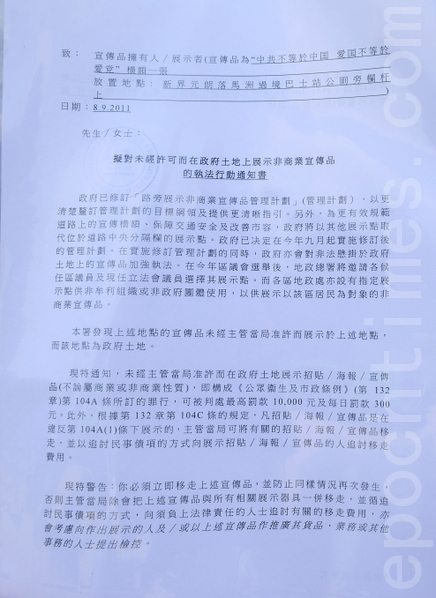

    法輪功學員呼籲制止迫害的橫幅,被當局貼上通知。(攝影:宋祥龍/大紀元)


    香港法輪功的真相展板和橫幅(攝影:宋祥龍/大紀元)


    法輪功學員在落馬洲擺放的各類真相展板,被食環署人員繫上限令拆除的通知。(攝影:宋祥龍/大紀元)

    香港法輪功發言人指出,他們的講真相活動,包括在公眾地方展示橫幅和展板等,都是在行使基本法所賦予的言論表達自由及和平集會示威權利,旨在申訴不公、反對迫害。所展示的物品,都是在每日活動開始時擺放,活動結束時收回,沒有阻礙行人、也未妨礙交通或損害衛生。這樣的合法又平和活動,不應受到當局的壓制。

    並且,他們所展示的橫幅、展板等等,都是用於揭露中共對法輪功人員的迫害事實,呼喚正義良知,反對迫害人權的普世價值,而食環署卻引用了一條管制商業廣告或宣傳品的法例來打壓市民和平示威的基本權利,明顯是引用條例失當。

    在過去10年間,法輪功學員一直在香港公眾地方進行這種形式的和平抗議,早已成為香港旅遊點的特殊風景線。近年來才開始受到食環署干預,可見當局背後是有人出謀,圖扼殺港人的言論自由,收緊港人自由表達意見的權利(如李克強到訪,在住家附近也不能穿六四衫)。

    香港法輪功發言人強調,香港市民有權在任何公眾地方行使和平集會示威的權利。香港終審法院2005年5月對法輪功學員被控阻街案的判詞早已表明,只要並非不合理地造成阻礙,市民都可以行使和平示威的憲法權利。當局任何干擾、破壞或侵犯活動物品的行為,包括強迫遷移、損壞或侵佔,都是違法行為,受害人將保留在法律上追究責任及追討賠償的權利。

    籲港人維護香港核心價值

    連日內,法輪功人員多次走訪食環署等有部門官員,向他們講清真相,據理力陳,並表明堅決拒絕移除橫幅、展板。據其中一名人員廖秋蘭透露,一些高層官員對於他們申明當局的做法踐踏基本權利,都顯得無可奈何、無言以對。

    法輪功發言人強調,當局這次以所謂交通市容、區議會選舉等事為藉口,拿來一些不相干的法例來打壓人權,等同於把這些法例變成惡法。就如同當年港府配合中共,以所謂國家安全為藉口進行23條立法,打壓港人的人權自由一樣。這次行動顯示港府當局再一次配合中共,把中共暴政延伸至香港,肆意踐踏香港的核心價值。廣大的香港市民不會同意,眾多有良知的公務人員也不會助紂為虐。

    如果任令「惡法」橫行,受到打擊的不單是個別團體,所有團體及個人都將身受其害。法輪功團體呼籲廣大市民毋忘溫水煮青蛙的警示,立即站出來維護香港的核心價值,制止大陸及香港政權不斷蠶食和踐踏香港的人權自由。

    各界齊轟當局踐踏基本人權

    事件引發了社會各界廣泛關注。據法律界人士表示,食環署所引用的《公眾衛生及市政條例》只是針對小商小販,不適用於行使示威權利的表達團體。人權監察總幹事羅沃啟在仔細研究了政府有關條文後指出,如果有條例去限制示威表達自由的話,相信這些法律肯定與基本法所保障的表達自由與示威權利抵觸。

    香港法輪功的真相展板和橫幅(攝影:宋祥龍/大紀元)


    2002年3月14日,十多名法輪功學員在中聯辦外抗議中共迫害,被警方拘捕並誣告以阻街、襲警等罪名。2005年5月,終審法院宣判所有罪名不成立。(大紀元資料圖片)

    羅沃啟:法例不應凌駕於憲法之上

    羅沃啟表示,十多年來法輪功人員一直在街頭、景點擺展板派傳單,當局藉著重新管制鐵欄上面的展示空間,而將矛頭指向法輪功學員,這是公民權利的倒退。羅沃啟強調,香港作為一個開放的社會就應該最大限度地去維護港人的表達自由,任何的法例都不應該凌駕這些權利。

    梁耀忠:當局公然恐嚇示威團體

    街工立法會議員梁耀忠直斥港府的做法是公然恐嚇示威團體,令人憂慮。特別是警務處長曾偉雄上台之後,打壓記者,透過不同的部門,不斷地打壓異見人士,令香港警察公安化。

    他指,曾經試過投訴工聯會等親共團體非法懸掛橫幅,但食環署只搜走橫幅,根本沒有懲罰性措施,但對付和平示威表達意見的團體,卻用惡法加恐嚇重罰來禁止市民表達不同意見。他強調,一定要跟進這件事。

    他認為,這次特區政府向法輪功下手,也是選擇在換屆之前向中共獻媚,事件令香港政府形象受損。他更憂心,特區政府已經成為中共的傀儡,完全沒有自主權,淪為了中共的打壓工具。

    梁國雄:整個公民社會受侵犯

    立法會議員梁國雄表示,這次署方以所謂區議會選舉為由拆橫幅,存在很多不清晰的地方。

    他呼籲香港市民要警惕政府侵權,根據國際公約,公民的基本權利、表達和言論的自由是基本人權。「今次不只是針對法輪功,其實是向整個公民社會一個侵犯來的。」不能讓政府以任何理由,限制市民的自由。

    立法會議員黃毓民表示,即使現在當局在區議會選舉前推出新的措施,也不能損害港人表達自由的權利。他認為今次是當局有計劃的行為,相信背後有中共的因素,因為法輪功反迫害令中共無法忍受。

    民陣:示威自由越來越緊縮

    民間人權陣線警權關注組發言人王浩賢指出,港府這種行動是對香港市民表達自由及權利的侵犯。市民有行動時,掛橫幅表達訴求,這是最基本的言論自由。他不明白為何一有選舉,市民自由表達的權利就要被壓制!

    他還指出,最近一連串事件,顯示香港示威自由越來越緊縮。2010年公眾集會拘捕人數只不過是53人,但是今年才過了8個月,已經拘捕了400多人。香港的社會問題明顯的越來越嚴重,而政府都不去解決,逼得市民要使用示威的方式,來表達訴求。

    http://www.epochtimes.com/b5/11/9/9/n3368001.htm

    Hong Kong Authorities Ban Falun Gong Roadside Display

    By Li Zhen & Lin Yi
    Epoch Times Staff
    Created: Sep 12, 2011 Last Updated: Sep 12, 2011
    Print | E-mail to a friend | Give feedback
    Related articles: China > Democracy and Human Rights

    Banners and display boards set up by Falun Gong practitioners in a public area in Hong Kong. (Song Bilong/The Epoch Times)

    HONG KONG—Every day in Hong Kong busloads of tourists from mainland China visit popular tourist sites where they encounter adherents of Falun Gong (also known as Falun Dafa) who have set up display boards and banners that tell about the spiritual practice and its persecution in China. If a new interpretation of a Hong Kong ordinance is allowed to stand, then such use of what are termed “roadside non-commercial publicity materials” will be banned, putting a crimp in the Falun Gong practitioners’ efforts to tell their story and limiting the rights of all Hong Kongers.

    According to Hong Kong Falun Gong practitioners, on Sept. 2 staff from the Food and Environmental Hygiene Department (FEHD) issued notices to different sites where practitioners have displays, including in front of the Liaison Office to Beijing (the Liasion Office is equivalent to China’s Embassy in Hong Kong), the Sogo Department Store at Causeway Bay, and the Wan Chai Bridge near the Immigration Department.

    The notice stated that FEHD will step up enforcement of Section 104A of the Public Health and Municipal Services Ordinance and demanded that the banners and display boards be removed. Violators could receive a maximum fine of 10,000 yuan (US$1,565) and a daily fine of 300 yuan (US$47).

    As of Sept. 8, Falun Gong practitioners at about a dozen locations in Hong Kong have received similar notices. At one of the sites, about a dozen staff members of FEHD arrived and attached Chinese and English-language versions of the notice onto the banners and display boards. They demanded that the Falun Gong practitioners remove the banners immediately because of the upcoming district council elections and remained for an hour. They also warned that they will soon take action.

    The practitioners’ activities at these sites began after the then-leader of the Chinese regime, Jiang Zemin, launched a campaign in July 1999 to “eradicate” Falun Gong. The practice, which consists of doing five meditative exercises and studying teachings based on the principles of truthfulness, compassion, and tolerance, had become very popular in China—in early 1999 an official with China’s Sports Administration indicated 100 million had taken it up. Some analysts say Jiang feared it posed a threat to the CCP.

    The practitioners call what they are doing at the sites around Hong Kong “clarifying the truth.” They seek to disabuse Hong Kong residents and visitors of lies told about by the practice by Chinese Communist Party propaganda. Inside China, the Party has used its control of the media and all parts of society to attempt to indoctrinate the Chinese people into opposing Falun Gong.

    Rights Threatened

    According to Falun Gong practitioners, the FEHD has taken an ordinance directed at commercial or promotional activities and applied it to their non-commercial activities. They say that by using display boards and banners they are exercising rights to freedom of speech and assembly that are constitutionally protected.

    Practitioners have refused to remove their materials. Instead, they have in the last few days been visiting government officials to explain their position.

    According to Falun Gong practitioner Liao Qiulan, some high officials have been speechless when practitioners have met with them and felt they couldn’t do anything about the Hong Kong government’s new initiative.

    Leung Yiu-chung, a member of LegCo, Hong Kong’s legislature, pointed to the Chinese regime as the reason for FEHD’s actions.

    “The Hong Kong Special Administrative Region government has already become the puppets of the Chinese regime,” he said. “They will suppress anyone the Chinese regime tells them to and have no sense of autonomy.”

    He pointed out that pro-communist organizations have illegally displayed banners before, but FEHD only took the banners down without punishing the organization members. By imposing punishment on peaceful protest groups, Leung said FEHD was clearly involved in “political suppression.”

    LegCo member Wong Yuk-man said that he believes the Chinese regime is behind this incident because it cannot tolerate Falun Gong practitioners’ peaceful protests. “The communist regime needs not command before the slaves carry out the work,” he said.

    Wong Ho-yin, a spokesman for the Civil Human Rights Front’s Monitoring Group Against Abuse of Power by Police, also stated that the Hong Kong government’s action is a violation of Hong Kong residents’ freedom and rights.

    “Are you saying that whenever there are elections, the rights of all the citizens should be suppressed? This is not reasonable,” Wong said.

    The spokesperson of the Hong Kong Falun Dafa Association pointed to an earlier court case as authoritative in the current situation. In May 2005, the Court of Final Appeal of Hong Kong dropped all charges against eight Falun Gong practitioners who held meditative vigil outside the Liaison Office in March 2002, citing that “the appellants were engaged in a peaceful demonstration in exercise of their constitutional rights.”

    According to the spokesperson, this case affirms that practitioners have the rights to freedom of speech and assembly in any public area.

    The spokesperson also indicated that Falun Gong practitioners reserve the right to hold the Hong Kong government accountable and to demand compensation should the government interfere with their activities or damage their property in an illegal way.

    Read the original Chinese article.

    chinareports@epochtimes.com

    Follow The Epoch Times’ China feeds on Twitter @EpochTimesChina.


    http://www.theepochtimes.com/n2/china-news/hong-kong-authorities-ban-falun-gong-roadside-display-61502.html


  • Urgent Appeal: South Korea Must Cease Deporting Falun Gong Practitioners to China

    Urgent Appeal: South Korea Must Cease Deporting Falun Gong Practitioners to China

    Young couple facing imminent deportation, 50 other Falun Gong asylum seekers at risk

    NEW YORK—The South Korean government must immediately take measures to ensure that no Falun Gong refugees be deported back to China, the Falun Dafa Information Center said Monday. Last week, immigration officials detained a 25-year-old Falun Gong practitioner and are holding him in detention for possible repatriation at any moment. Should he be deported, he faces serious risk of imprisonment, torture, or even death.

    “Sending Falun Gong refugees back to China is inhumane, unjust, and contrary to international law.” says Levi Browde, Executive Director of the Falun Dafa Information Center. “We urge the South Korean government to resist any pressure coming from the Chinese Communist Party (CCP) and offer Falun Gong practitioners a safe haven from persecution.”

    “We know in the past that the South Korean government has allowed Falun Gong practitioners to safely stay in South Korea even without official asylum status, and we urge them to resume this practice.”

    On September 6, 2011, two Ministry of Justice officers and four local police went to the home of 25-year-old Mr. Jin Jingzhe and his wife Ms. Ma Yue. They arrested the couple on the grounds of their illegal immigration status after their applications for asylum had been denied. Mr. Jin was then taken to the “foreigners protection detention center,” where staff told him that he had seven days to write an appeal application explaining why he should not be repatriated. Ms. Ma remains outside of custody. According to one source, in addition to Jin, another Falun Gong practitioner, Shen Xianzhi, also remains at an immigrant detention center facing potential deportation.

    Since 2009, South Korea has sent at least 10 Falun Gong refugees back to China, indicating the danger facing the couple. At present, an additional 56 Falun Gong students residing in Korea have been denied asylum. If detained by police, they too risk deportation to Mainland China. 

    The Falun Dafa Information Center is calling on the government of the Republic of Korea to honor its commitments under the United Nations Convention on the Status of Refugees and the Convention Against Torture. South Korea is a signatory to both treaties, which prohibit returning refugees to countries where they would be subjected to torture or persecution on account of their religion or membership of a particular social group.

    Falun Gong practitioners, regardless of their profile or prominence within the Falun Gong community, all face the possibility of arbitrary detention, extra-legal sentencing, and torture in China. Hundreds of thousands of Falun Gong prisoners of conscience are believed to be detained in China for their beliefs; in some detention facilities, they comprise the majority population. The United Nations, Amnesty International, Chinese human rights lawyers, and Western media have documented Falun Gong torture and deaths at the hands of Chinese officials. In its annual report released in early 2011, Amnesty International stated that Falun Gong practitioners who refused to renounce their beliefs “are typically tortured until they co-operate; many die in detention or shortly after release.”

    The Falun Dafa Information Center therefore calls on:

    • The South Korean government to immediately halt all deportations of Falun Gong practitioners to China and take measures to grant them asylum.
    • The South Korean National Human Rights Commission to investigate and respond accordingly to previous cases of Falun Gong repatriations.
    • The international community, including human rights groups, foreign government officials, and concerned citizens, to immediately contact representatives of the South Korean government and urge them to protect Falun Gong refugees.

    Additional information

    Mr. Jin first learned Falun Gong in China with his mother when he was in elementary school. After the Communist Party launched the campaign to persecute Falun Gong in 1999, Jin was forced to drop out of high school and his mother was held at a Beijing labor camp. In 2008, Jin arrived in Korea Korea, where he has been an active member of the Falun Gong community.

    Among other activities, he has worked as a reporter for the independent station New Tang Dynasty Television, covering various stories considered politically sensitive by the CCP. These included local Falun Gong practitioners’ appeals for an end to human rights abuses in China and stories related to North Korea.  

    In recent years, 23 members of the U.S. Congress have written to the government of the Republic of Korea seeking their help in protecting Falun Gong practitioners on humanitarian grounds, but the repatriations have continued. Roger Helmer, a member of the European Parliament, wrote on September 9 to the South Korean Ambassador in the United Kingdom, voicing his concern for the couple and requesting assurance that Korea would fulfill its international obligations to asylum seekers.

    http://www.faluninfo.net/article/1163/


  • 电影《机缘》(87分钟) Movie “Destined”

    Uploaded by on Jun 14, 2011

    中国大陆用户通过动态网或无界浏览软件翻墙后,可下载整部电影。地址为http://cnonly.dongtaiwang.net/html/jiyuan.html 。由于版权原因,中国大陆以外用户的IP将无法从动态网上下载整部电影。

    中国大陆以外的人士,可以在这里欣赏影片的前87分钟(中英文字幕)。如果网络速度允许,建议画质选择为高清版(720p)观看。最后六分钟的大结局受版权保护,可以到开­­元音像的网站上付费下载。
    Audience outside mainland China can watch the first 87 minutes here. The last 6 minutes of this movie is copyright protected. It needs to be downloaded from Premier Music & Video, Inc.

    下载地址为https://premierinconline.com/index.php?target=products&product_id=361
    The download URL is https://premierinconline.com/index.php?target=products&product_id=361


  • 加议员与新华记者暧昧信曝

    2011年9月8日,加拿大保守党国会议员、外交部长国会秘书鲍勃‧德克特(Bob Dechert)与中共新华社驻多伦多记者施蓉的暧昧电子邮件与照片被曝光。(网络截图)

    加议员与新华记者暧昧信曝光 间谍说再起

     
    【大纪元2011年09月10日讯】(大纪元记者唐文综合报导)9月8日,加拿大保守党国会议员、外交部长国会秘书鲍勃‧德克特(Bob Dechert)与中共新华社驻多伦多记者施蓉的暧昧电子邮件被曝光。9月9日,德克特承认发送了暧昧电子邮件并发表声明道歉。加国媒体直指新华社是中共情报机构,质疑中共间谍渗透加拿大政府,中共“间谍说”再起。
    /* FillSlot(“DJYcn_articles_below-header”);*/

    暧昧电子邮件 大面积曝光

    据加拿大《环球邮报》报导,9月8日,逾240位媒体、学术和政治圈人士收到了大量电子邮件,邮件内容是国会议员鲍勃‧德克特(Bob Dechert)写给中共新华社驻多伦多记者施蓉的,信中包括“你很漂亮”、“我很想念你”等调情内容。报导选登了一些调情电子邮件。

    一份于2010年4月17日从德克特的议会办公室帐户发给施蓉的电子邮件说:“你这么漂亮。我真的很喜欢你在湖畔脸颊粉扑的照片,看起来是那么可爱,我喜欢你这样。现在,我更想念你。”信件署名为:鲍勃‧德克特,国会议员。

    在另一封2010年4月20日的电子邮件中,德克特邀请施蓉观看一个在渥太华举行的下议院投票的电视直播,并说:“我将对你微笑。”德克特在信中还称“开车时想你的感觉真好”;在信的结尾说:“我想念你。爱,鲍勃”。

    议员德克特声明道歉

    9月9日,德克特在其官方议员网站发表声明,承认发送了暧昧电子邮件,并向所有受伤害的人表示道歉。德克特称,施蓉是他在负责华文媒体联络时认识的一个朋友,并称,他们之间只是纯洁、简单的朋友关系。

    对于他的电子邮件为何被曝光,德克特在声明中表示:“黑客入侵施蓉的电子邮件是她持续的家庭纠纷的一部份。”

    德克特是加拿大外交部长约翰‧贝尔德(John Baird)的国会秘书,出生在安大略省宾顿市(Brampton),2008年当选国会议员之前是一名律师。德克特的议员网站称,德克特与妻子露丝‧克拉克(Ruth Clark)在密西沙加生活了多年。

    施蓉本人9月8日晚向《环球邮报》表示,有骇客侵入了她的邮件信箱,并指责自己的丈夫侵入了她的邮箱。但她不愿证实电子邮件的内容是否真实。

    加媒关注中共间谍

    《环球邮报》在报导中指出,中共一直积极从事海外情报收集,去年加拿大安全情报局(CSIS)局长法登曾警告,中共间谍已渗透到加拿大政治。西方国家的反间谍组织一直将中共官媒新华社当作一个情报机构。2003年,加拿大联邦政府曾将一个华裔幕僚炒鱿鱼,因为发现她曾任职于新华社,在联邦政府工作期间却依然和新华社有联系。

    《赫芬顿邮报》报导指出,德克特作为外交部长的国会秘书,能参与、接触加拿大政府的机密信息。2009年,德克特曾陪同加拿大总理哈珀访问中国。有地方媒体曾报导德克特对中国商务贸易特别感兴趣。

    法登:中共间谍已渗透加拿大政治

    去年6月底,加拿大安全情报局(CSIS)局长法登(Richard Fadden)在加拿大广播公司(CBC)的专访节目中指出,加拿大的某些政府官员和加拿大的民主正受到来自外国的秘密影响。

    法登披露的问题是,至少在加拿大的两个省份中,有内阁厅长受到外国政府控制;卑诗省的几个城市,有政府公务员在被怀疑之列;加拿大安全情报局的一半反间谍开支,用来应付中共政府的间谍。

    提起媒体对中共间谍在加拿大活动的一些报导,法登说,这些报导“并非完全不对”;至少有5个国家在加拿大的大学暗地里招募政治人才。中国是这些国家中最活跃的,由其使领馆操控,向有关的大学俱乐部提供资金。媒体马上做出了相关报导。

    /* FillSlot(“DJYcn_articles_below-header”);*/

    维权律师:中共渗透“实际情况更严重”

    法登(Richard Fadden)曝光外国政府渗透加政要后,在西方社会掀起轩然大波,对中共体制很了解的中国著名维权律师郭国汀,从自己观察的角度,剖析由此引起的间谍现象,认为“这是中共的战略、政策,”“肯定是事实,实际情况更严重得多”。

    郭国汀表示,法登提到的外国政府对西方社会官员的渗透影响,“肯定是事实”。他认为,如果西方官员被中共间谍盯上,如果不是100%,也是80~90%被拖下水,“因为人都有弱点,而特务就投其好,或送金钱,或色欲诱惑,也有赠送特殊的艺术品,让官员受到帝王般的待遇,自然就使其改变。”

    郭国汀指出一个特别现象,就是“凡是到中国访问过的官员,回来后对中国态度180度改变,原来对中共印象非常不好的人,回来后,大大称赞中国。”

    郭国汀忠告西方官员:“不要与邪恶、流氓打交道,永远也占不到便宜,一定是!可能一时半会儿,得到了利益,最后将是赔老本,倾家荡产。”他劝告政要,如果必须打交道,“那就必须保持高度的警惕,否则一失足成千古恨。”

    中国前驻澳大利亚外交官陈用林2007年6月3日到12日对加拿大4个城市进行访问,他在包括首都渥太华国会大厦新闻发布会等处,多次公开表示,中共内部文件披露中共驻外有大量间谍和线人,在加拿大就有约1千间谍。他并指出,像覆盖全球的华人组织“华联会”、“促统会”等团体都是中共操控的政治工具。

    中港台时间: 2011-09-10 20:42:44 PM 【万年历】
    本文网址: http://cn.epochtimes.com/gb/11/9/10/n3369122.htm加议员与新华记者暧昧信曝光-间谍说再起
     

  • 持刀捅官1死4伤 晋朔州强拆血&

    持刀捅官1死4伤 晋朔州强拆血战真相 [In China, State-Backed Land Grab Destroys Family]

    从2007年开始,朔城区政府在没有任何拆迁手续,未对拆迁户进行任何补偿安置的情况下,开始对府东巷一带的房屋进行强制拆迁。当地有三户居民被投雷管,引起强烈爆炸,其中一户还引起了火灾,差点出人命。(当事人提供)
     
     
    【大纪元2011年08月19日讯】(大纪元记者古清儿报导)山西朔州“6.23”暴力强拆血案,曾经闹的沸沸扬扬、轰动全城。被拆迁户吴学文面对200 多人的强拆队伍,和家人为守护家园爬上房顶奋力抵抗,吴面对暴力被逼持刀反击,造成包括建设局长在内的一死四伤的事件。而吴妻乔香莲在案发18小时后,死于朔城区公安分局。


    71岁的王先梅仍失去自由,由专人保护“安全”。图为其家属获准探视她,身上现在仍看到事发时被殴打留下的伤痕。(当事人提供)

    强拆房屋是残疾儿子的赔偿金购得

    47岁的吴学文是大同浑源人,43岁的妻子乔香莲是大同灵丘人。吴家有个70多岁的老母,大儿子吴瑞曹是朔州职业技术学院二年级学生,小儿子吴瑞安是朔州区第一中学高三学生。

    吴瑞安在四岁时出了车祸,右腿脚踝以下截肢。2003年,吴家买了朔城区府东巷的一院平房,这是80年代当地政府修的“干部院”。这房屋是用吴瑞安的伤残赔偿金购得。

    吴家位于朔城区府东街71号,有七间房子,大约有120多平方米。中间的三间正房自己居住,西边的三间是门面房,一间出租给理发店,两间自己开商店,一家人靠门面店为生,房屋拥有合法的房产证和土地使用证。

    在朔州,府东巷属于黄金地段,房价节节攀升,商品房每平方米要价4,000元。强拆前,朔城区法院的何副院长和吴家商议的最后结果是:给吴家一套100平方米的住宅楼和一套商铺,如果补偿款不够购买商铺,由吴家自己出钱补齐。当时,何副院长答应吴家回去向领导请示,然后给吴家一个满意的答覆。但吴家人万万没有想到,他们等来的却是家破人亡的悲剧。

    从2007年开始,朔城区政府在没有任何拆迁手续,未对拆迁户进行任何补偿安置的情况下,开始对府东巷一带的房屋进行强制拆迁。吴家强拆前,先后被人往院子里扔砖头、砸玻璃、砸人,甚至扔雷管。

    吴瑞曹表示,他家多次被逼迁,当地有三户居民被投雷管,引起强烈爆炸,其中一户还引起了火灾,差点出人命。
     
    当地民众反映,朔州市朔城区暴力征地、强拆事件几乎天天在上演,近期,在照甚八庄村、东关、北刑家河、张家河村等多地发生了多起强征强拆,拆迁办雇凶殴打无辜村民,伤者众多。市民呼吁关注和介入。

    http://www.epochtimes.com/gb/11/8/19/n3348300.htm

    In China, State-Backed Land Grab Destroys Family

    By Gu Qing’er
    Epoch Times Staff
    Created: Sep 10, 2011 Last Updated: Sep 10, 2011
    Print | E-mail to a friend | Give feedback
    Related articles: China > Democracy and Human Rights

    Chinese authorities carry sticks as they prepare to stand guard before workers demolish houses which are claimed illegal by local government in Wuhan, central China’s Hubei province on May 7, 2010. Land seizures have been a problem for years in China and forced evictions have not been uncommon. (AFP/Getty Images)

    Wu Ruian, a grade 12 high-school student with a disabled left foot and prosthetic right leg, clambered onto his roof to defend the family home recently. He wasn’t defending it from bandits, but rather government officials and their cronies. They’d come to demolish the building so they could make a killing from selling the land.

    He took off his pants to show his left foot, yelling to the demolition crew: “If you still have human nature, do not tear down our house.”

    The crew ignored him. Enraged, he threw his prosthetic leg onto the street. It did little good. The incident would end with a dead official, a broken family, and a demolished house.

    The Wu family’s ordeal is one of the many dramatic stories of forced demolition as it plays out on the ground in China. This account was told to The Epoch Times in a series of interviews recently. It has become known as the “6.23 Shanxi Incident” on the Chinese Internet.

    Though the incident took place on June 23 in Shuozhou, Shanxi Province in central China, it didn’t come to light until Aug. 6.

    Then, Wu Caorui, the eldest son of homeowner Wu Xuewen, 47, escaped police custody and revealed what had happened.

    On June 23 a 150-member demolition crew led by a district-level Party official surrounded Wu’s Xuewen’ residence at around noon. The team comprised members of the court, police, street cops (known as Chengguan), the city’s building department, and hospital and fire-brigade staff.

    They knew that the demolition wouldn’t be easy.

    Wu Xuewen, the owner, had armed himself with a knife when he learned of the demolition team’s approach.

    They talked it over but, unable to reach an agreement, decided to atop their house roof for the defense. Wu Xuewen, his wife, his mother, and his younger son with the prosthetic leg, Wu Ruian, all climbed up.

    Wu Caorui, the elder son and a sophomore in a local technical college, stood outside the house and begged the officials to stop. They ignored him. As a bucket loader was approaching the roof, an official gave the order: “Get rid of this guy first.”

    Over 20 armed police dragged Wu Caorui away and beat him unconscious with batons. He was handcuffed and thrown into a police van.

    As he regained consciousness in the van, he found that his family members were being thrown in too, handcuffed and brutalized.

    His mother was covered with blood, both her arms had been hit, and she was crying out. His father was also badly injured and exhausted.

    The father, Wu Xuewen, had actually just killed one of the officials. A man had pretended to be willing to negotiate with Wu, and held out his hand, as if to shake in reconciliation. But when Wu extended his hand he was seized by the throat and the grip on his right hand tightened. Another official shouted: “Beat him, beat him to death.”

    The terrified father tried his best to fight back and took out a small knife hidden inside his trouser leg. He stabbed his assailant in the neck. Other officials quickly jumped into the fight and put him down.

    Wu’s disabled younger son was not spared either. The attackers sprayed an unidentified liquid into his eyes, blinding him temporarily.

    All told, one official died during the conflict, while four others were injured. But the officials would get their vengeance.

    Upon arrival at the Shuocheng District Police Station the young son, the mother, and the grandmother, were interrogated separately. The mother and grandmother were placed in handcuffs and footcuffs and subject to lengthy interrogations.

    The mother passed out many times during the interrogation. It is unclear what methods the police used, but eighteen hours after the incident, on the afternoon of June 24, she was dead.

    Wu Caorui was notified of his mother’s death but not allowed to see the body. Along with his grandmother and brother, the family was monitored by Public Security Bureau and not allowed to move about freely. Uncles and other family members needed to get permission before seeing them.

    On July 2 Wu Quan, an attorney at Hebei’s Xingwei Attorney Office, was entrusted by an uncle to be the defense counsel for the family. But on the afternoon of July 11 he was attacked by unknown men.

    The two brothers, and one sister, were staying in a hotel when the unidentified men burst in on them. Wu’s brother was pressed to the floor and had his head slammed against the ground.

    Since 2007 authorities in Shuocheng district had been forcefully demolishing houses in the Wu family’s neighborhood, without legal documents, compensation, or alternative arrangements for the residents.

    In the lead-up to this dramatic demolition struggle, the authorities had taken a number of measures to try to force the Wu’s out: throwing bricks at their house and smashing windows, and even throwing a bomb into their home.

    The house had actually been bought with the compensation money received when Wu Ruian, the younger son, was crushed in a car accident at age four. His right foot below the ankle was amputated.

    It was an over 120 square meter bungalow, bought in 2003; one part was the residence, while the other part was used for the family business.

    Wu Ruicai said that his neighbors had encountered similar incidents: bombs had been thrown into three houses in the area, with one of the places catching fire as a result of the blast.

    Wu Xuewen’s defense attorney said that the entire process of demolition was illegal. The authorities didn’t allow lawyers to meet with the family and instead arranged their own lawyer. The process of appointment of that lawyer was illegal too, he said.

    Detaining Wu Xuewen’s mother and two children was also illegal; the behavior of the court staff and that of the public security officials were also all illegal, this lawyer said.

    According to local residents, authorities in Shuocheng District of Shuozhou City regularly use violence to obtain land. Forced demolitions are carried out almost every day, residents said, with thugs working with local officials to evict residents so the houses can be bulldozed and the land sold to developers.

    China is currently in the midst of a real-estate bubble, partly because local governments derive most of their revenues from land sales. The case of the Wu family is a dramatic illustration of this dynamic as it plays out in individual houses across the country.

    Read the original Chinese article.

    chinareports@epochtimes.com


  • Watching the Mid-Autumn Moon

    Watching the Mid-Autumn Moon

    Chinese moon festival traditions & poetry

    By Zhi Zhen Created: Sep 9, 2011 Last Updated: Sep 9, 2011
    Print | E-mail to a friend | Give feedback
    Related articles: China > Culture

    Painting by Xiao Yun based on a poem by famous Tang Dynasty period poet Li Bai, “Drinking alone with the Moon.” (The Epoch Times)

    The Chinese Mid-Autumn Festival falls on Sept. 12 this year. It’s the night when the moon is full and near to earth, and shines most brightly. On this major Chinese holiday families and friends gather to enjoy each other’s company, share food, and eat moon cake. The holiday is based on the lunar calendar and has a tradition that goes back many centuries.

    Since ancient times, the moon had rich meaning to Chinese people whose calendar, planting season and life were all tied to the moon. The moon also held deeper mysteries in ancient Chinese culture and has been the subject of legends and poetry.

    Traditionally, Chinese people would stand on a high hill in the cool, crisp autumn night, or simply open their windows, to watch the bright full moon, marvel at its beauty, and send prayers and wishes to the moon goddess.

    The moon was given different names depending on its phase and fullness. It is called silver or jade hook, jade arch or arch moon, or golden wheel, silver plate or jade mirror, as it goes through its phases.

    The Legend of Chang Er

    Many well-known legends about the moon have been passed down, including the ones about Wu Gang chopping down the Cassia tree and Chang Er being banished to the moon.

    Chang Er was the beautiful wife of Hou Yi, an archer at the imperial court. According to the legend, there were ten suns in the sky during prehistoric times, and the heat made life for humans very miserable. Hou Yi, being an accomplished archer, shot down nine of the suns. For this, a goddess rewarded him with a magic immortality potion.

    Hou Yi gave the potion to Chang Er for safekeeping, but Chang Er drank the potion, and as punishment the goddess banished Chang Er on the moon. It is said that the moon was enhanced by Chang Er’s beauty, and ever since then, Chinese people have gathered during each autumn moon to admire the moon and eat moon cake in her memory.

    History of Moon Festival

    The Mid-Autumn Festival has a long history in China. The term “Zhongqiu,” or Mid-Autumn, first appeared in a book believed to be from the middle of the 2nd century BC called the Rites of Zhou, also known as Zhouli, which, among other things, depicts a ceremony that people held to show veneration for the moon.

    During the Tang Dynasty (618-906 AD), the ceremony became more popular, and the Mid-Autumn festival was designated as an official holiday. August 15 in traditional Chinese lunar calendar is documented as the date of the Mid-Autumn festival in the Book of Tang, known as Tang Shu or Taizong Ji.

    The Festival became even more widely celebrated after the Song Dynasty, and during the Ming and Qing Dynasties it became one of the major holidays in China, as important as the New Year.

    Poetry

    Throughout history, many poems and songs about the moon and mid-autumn have been written, simply too numerous to be counted. Some can be found in the book Shi Jing, a collection of Classic Poetry, which first appeared in the middle of the second century BC.

    Writing poetry was an art form and also a philosophical and spiritual discipline that was widespread among scholars and officials, even emperors. The clear, bright moon inspired ancient poets as a symbol of purity, nobleness, and broadmindedness. Others also saw it as a heavenly mystery to be contemplated.

    “It was not the east that was bright,
    it was the light of the moon coming forth,”
    is a line from the Shi Jing.

    “How wide the world was, how close the trees to heaven.
    And how clear in the water the nearness of the moon!”
    is a poem by Meng Haoran (689–740 AD).

    “The stars lean down from open space,
    and the moon comes running up the river,”
    is part of a poem by Du Fu (712-770 AD).

    “The moon, grown full now over the sea,
    setting right the whole of heaven,”
    is by Zhang Jiuling, a prime minister in the Tang Dynasty.

    The famous Chinese poet Li Bai (701-762 AD), of the Tang Dynasty, wrote a poem titled “Drinking alone with the Moon,” which seems to speak of humanity lost in delusion and loneliness, yet still yearning for a connection with heaven.

    “From a pot of wine among the flowers, I drank alone.
    There was no one with me–till, raising my cup,
    I asked the bright moon,
    to bring me my shadow and make us three.


  • 上海大火4千万善款消失?受

    上海大火4千万善款消失?受害人要真相 [Shanghai Fire Victims Claim Donations Were Embezzled]

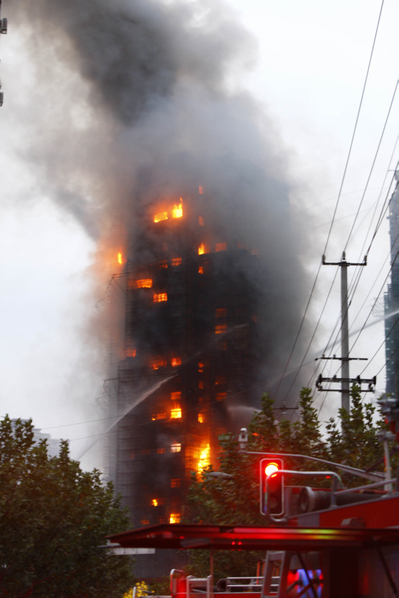
    2010年11月15日,上海市静安区一幢28层教师公寓发生大火。(大纪元资料室)
     
     
    【大纪元2011年09月07日讯】(大纪元记者洪宁报导)近日,上海“11•15”静安大火善后风波再起。灾后社会各界共捐款4,480万元,如今只有约420万元发放到受害人手中,另有4,000多万元去向不明。目前,21名受害人作为维权代表已委托律师追查善款去向,并要求当局将善款使用真相公布于众。
    CreateDomIframe(“google_ads_div_DJYwww_articles_news_below-header_ad_container” ,”DJYwww_articles_news_below-header”);
  • 世界媒体看中国:李双江的

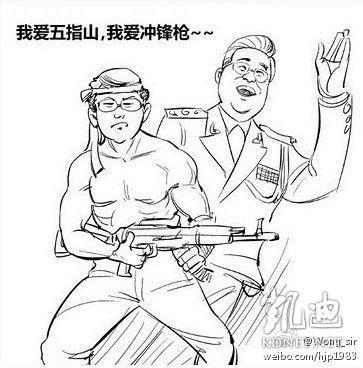
    中国网民改写李双江所唱红歌的歌词,恶搞李双江父子。(网络图片)

    世界媒体看中国:李双江的新闻

     
    【大纪元2011年09月10日讯】近日,中国歌手李双江之子,开无牌照宝马携带“冲锋枪打人事件在社会上引起很大的关注。世界媒体纷纷报导这又一起“我爸是李刚”事件,并分析指出中共官媒报导不但与中国民众视角不同,而且刊发英文、法文新闻,试图引导外部世界看中国。
    /* FillSlot(“DJYcn_articles_below-header”);*/

    李双江再以儿子出名

    据美国之音报导,1970年代中期,也就是所谓的“无产阶级文化大革命”后期,中共当局推出“文革”开始后的第一批故事片。中共军队歌手、现任中国人民解放军艺术学院音乐系主任李双江为那些屈指可数的故事片之一《闪闪的红星》演唱插曲“红星照我去战斗”,一举成为全中国最著名的歌手之一。

    报导指出,近年来,随着中国的歌迷有了多得数不清的中外歌手歌曲可听(今年以来,被中共文化部列入黑名单的中外歌曲就有三百首),李双江已经被许多歌迷认为是个过气的歌手,难以引起轰动了。

    然而,近两天来,李双江的名字又产生了轰动效应,甚至产生了国际回响,得到了海外媒体的报导,以至于中共官方媒体也为他刊发英文、法文新闻,由此引导外部世界看中国。

    李双江的名字又产生轰动效应,是因为他的15岁的儿子李天一。9月6日晚上,李天一无照开车,开着没有挂牌的宝马牌高级车。因为他前头一对夫妇开着车突然刹车,他便暴怒起来,下车对那对夫妇拳打脚踢。

    中国媒体报导说,那对夫妇的5岁的孩子在车里吓得哇哇大哭;李天一的一个朋友开着另一辆车,也停车跟他一起殴打;李天一和朋友显然是出手凶狠,而且一边打,一边威胁旁观者不得打电话报警。被殴打的彭姓男子随后被送到医院,头上要缝11针。

    有关的消息最先在《新京报》得到报导,随后中国互联网上传开,成为中国民众的微博热议话题。

    美国之音:民众与官媒视角不同

    美国之音报导指出,权贵或被认为是权贵的人家的子女在社会上无法无天横行霸道,以及官方为权贵及其子女保驾护航,近年来频频成为爆炸性新闻,成为民怨爆发的导火索,威胁中共当局苦心经营的“和谐”稳定。“我的爸爸是李刚”,“药家鑫”,“俯卧撑”成为当今外国学者了解和研究当今中国官民对立、权贵与小民对立的最佳索引。

    跟以往的类似重大新闻事件一样,中国的民间舆论跟官方媒体在观察、表述和评论同一个事件的时候,显示出迥然不同的视角差异。

    新浪微博的一个帖子可说是相当典型地代表了中国民间的视角:

    a_ring在Jakarta:“刚看到新闻的时候义愤填膺好一阵,现在想想看,最后的结果其实是没什么悬念的,必定会被压下去最后不了了之……无论微博上喊得多大声,最终他们的权利还是大过天,官二代也好,军二代也罢,说到底都是富二代,真是一个也伤不起啊!”

    有网民将李双江唱过的红歌“红星照我去战斗”改写为歌词“红爹罩我去战斗”,讽刺中国官二代。歌词称“小小宝马无牌遛,套牌奥迪跟我走,有人挡我路,直接上拳头,打架斗殴一起上,爹的教导记心头。小小年纪实在牛,不由分说把人揍,红爹闪闪亮,罩我去战斗,坑爹二代如潮涌,前仆后继跟爹走,砸碎所有的穷光蛋,万人面前把脸丢,把脸丢。”

    中共官方的新华网英文新闻和英文《中国日报》的标题,以及中共机关报《人民日报》法文网站有关新闻的标题,则可以说是相当典型地代表了中共官方的视角,它们分别是:
    Respected Chinese tenor faces the music over son’s disregard for the law(受人尊敬的中国男高音歌手面对儿子无视法律招致的各种批评——新华网,9月9日);Singer apologizes for son’s attack(歌手为儿子打人道歉——英文《中国日报》,9月9日);Un chanteur presente ses excuses pour l’attaque perpetree par son fils(歌手为儿子打人表示道歉——《人民日报》法文网站,9月9日)。

    /* FillSlot(“DJYcn_articles_below-header”);*/

    至少从标题来看,对李双江儿子打人一事,中国民间和官媒展现出截然不同的视角。民间视角着重权贵及其家人可以肆意欺压民众;官媒视角则着重打人一方的家人通情达理。

    新华网的英文报导标题当中的“music”可谓可圈可点。music最常用的字面意思是“音乐”,“悦耳动听的话”。现在不清楚新华网在这种场合的这种新闻标题中选用这样的一个词,是因为英文不灵用词不当,还是意图对李双江和中国社会及政治进行讽刺挖苦。

    报导特别注明,美国之音也不清楚在这里把新华网的“music”翻译为“各种批评”是否是正确或准确,是否应当把那英文标题翻译为“受人尊敬的中国男高音歌手面对儿子无视法律招致的音乐(或,悦耳动听的话)”。

    日媒报导更接近中国民众的观点

    日本媒体对中国这一最新热议话题新闻跟踪最紧。以下是9月8和9日的日本媒体的一些新闻报导标题,明显跟中共官媒不同而更接近中国民间的观点:

    “北京:一边打人一边叫喊:‘谁敢叫警察?’ / 军队歌手的15岁的儿子 – 特权阶级 /(民众)不满爆发” (时事社,9月8日)

    “中国:特权阶级的子弟、15岁无照驾车而且飙车、因前车突停发怒、向对方施暴”(《每日新闻》,记者成泽健一,9月9日)

    “中国:超有名歌手溺爱的15岁儿子无照飙车、对市民施暴”(工商金融新闻网站Searchina,编辑柳川俊之,9月8日)。

    西方媒体:又一起“我爸是李刚”

    与此同时,西方国家以及菲律宾、科威特国的英文媒体则广泛转载法新社从北京发出的一篇英文报导,题目是,“Chinese army general under fire for son’s violence”(中国军队将军因为儿子的暴力行为受到强烈批评)。

    日本《每日新闻》和法新社都在报导中提到了当今中国的名言名句“我爸爸是李刚”。

    法新社的报导说:“这一事件立即在互联网上招致众人要求惩罚李天一。中国公众憎恶他们一些人所认为的高官及其家人的骄横。中国最火的微博网站新浪微博上,有一个用户对李双江提出了强烈的批评。”

    “这位用户发贴说,‘李双江是个什么人?他的儿子才15岁,但开着宝马带着枪。中国这是怎么啦?’这位用户在这里所说的枪,是指李的儿子在被拘留的时候,在他的车里据报发现了一把玩具冲锋枪。”

    “另一位网民则说:‘太棒了。中国就是因为有这么一帮人才腐败。’”

    “在去年的丑闻中,北方的河北省一个警官的22岁的儿子开车轧了一个学生,然后向周围的人大叫:‘要是想起诉,就起诉我吧。我的爸爸是李刚。’”

    “这两个案件让公众越来越注意中国所谓的‘富二代’的坏名声。‘富二代’是指享受了中国三十年来经济大发展的权势人家的后代。”

    记者探访伤者被阻

    美国之音报导指出,在中国,中共当局认为是敏感的话题,往往就是民众特别关心的话题。李双江儿子打人的话题显然是这两天中国民众特别关心的话题。在北京时间星期六凌晨两点半,新浪微博关于这一事件的帖子已经接近150万。

    最新的帖子包括如下一条:“lym9042252:道歉背后,尽显将军威严!李天一打人事件过后,多路记者赶到309医院,李双江刚刚离去,记者正欲探访伤者,医院派人将记者拦出病房。《京华时报》记者证件被没收,并被告知到宣传部登记。找到病房,没人。费周折找到新病房被武警拦下,禁入。《娱乐现场》记者表示拍摄时遭恐吓,声称再拍就把机器砸了。”

    (责任编辑:肖笙)

     
    中港台时间: 2011-09-10 11:01:45 AM 【万年历】
    本文网址: http://cn.epochtimes.com/gb/11/9/10/n3368935.htm世界媒体看中国-李双江的新闻
     

  • 王华:毛泽东PK林彪 谁输谁赢&

    林彪与毛泽东,可谓一对冤家上演一场双簧。(网络图片)

    王华:毛泽东PK林彪 谁输谁赢了?

    /* FillSlot(“DJYcn_articles_comentary_below-header”);*/
    【大纪元2011年09月11日讯】9月9日,是毛泽东死去35年的日子,9月13日,是林彪坠落温都尔汗40年的日子,两人死期相近,加上从“亲密战友”到“谋杀仇敌”的突变,人们自然而然很容易把两人拿来对比PK一番。

    毛泽东与林彪首先是个整体,狼狈为奸、密不可分。1949年前,没有林彪为毛打下三分之二以上的江山,毛也登不上天安门城楼;1958年,没有毛的提议,病病泱泱的林彪也不会重返政治舞台;1966年,没有林彪高喊“万岁、万岁、万万岁”,也不会有毛的火红文革;没有林彪的枪杆子护卫,毛也斗不垮刘少奇,以此为交易,1969年,毛把林彪作为接班人写入了中共党章,这在全人类各国政党的历史上也是绝无仅有的。

    其次,毛林二人也是大冤家、死对头。选定接班人不到一年时间,多疑猜疑的毛就后悔了,他发现真正能继承其衣钵的,只有自己的老婆江青,连表面顺从的周恩来、邓小平等人,都会在毛死后鞭尸毛,于是毛决定要像打倒刘少奇那样打倒林彪。毛林此时已经是水火不容了。

    不过与刘少奇的糊里糊涂被整不同的是,林彪是个聪明人,这位从来没有打过败仗的“常胜将军”,不但智商超人,关键是他了解毛的阴暗险恶。当毛刚想加害自己,林彪就察觉出来了。所以中共九大后,无论毛如何利用程咬金的三板斧:扔石头、掺沙子、挖墙脚,或用周恩来的认错来诱导林彪,想让林站出来认错,以便藉机取消其接班人资格,进而把林打下台,但看清局势的林彪一直按兵不动,让毛的“废后”计划无法实施。

    最后毛不得不借1971年8月南巡之机,拿自己的身体当诱饵,来引蛇出洞、敲山震虎。假如林彪只是一个人,也许会坚持按兵不动的方针,谁知林家是4口之家,老婆叶群最先害怕了,怕毛先拿她开刀,哭着喊着要逃亡香港,儿子林立果,青年才俊,一腔热血,初生牛犊不怕虎,想跟毛斗一番,出一口恶气,让人看清毛有多么邪恶;假如没有人告密,也许林家不会败得如此一塌糊涂,女儿林豆豆,跟亲身母亲叶群确是对冤家,叶群到处说女儿是精神病,女儿也把全家的秘密主动报告了中央警卫团,让毛周能提前知道林彪的出走计划。

    接下来的事就出乎所有人的意料了。简单的说,人算不如天算,一切都是老天爷安排的。面对林的出走,毛说了句:“天要下雨,娘要嫁人,随他去吧”,林彪的飞机还有几吨油,却不得不在蒙古境内迫降,最后机毁人亡。

    口是心非的林彪,落了个不得好死的下场,而毛又反过来利用林的死给自己背黑锅。至今林彪的名字依然在“林彪、江青反革命集团”的黑名单上,替毛背负文革的罪过。不过反过来,林彪的死,也自动宣告了文革的破产,毛的彻底失败。从那以后,中国人就再也不相信毛了。

    这里面到底谁输谁赢了?历史可能没有赢家,罪人永远都是罪人。

     
    中港台时间: 2011-09-11 05:24:01 AM 【万年历】
    本文网址: http://cn.epochtimes.com/gb/11/9/11/n3369623.htm王华-毛泽东PK林彪-谁输谁赢了?
     

  • CCP Politburo Committee Directed Google Hacking: WikiLeaks

    Uploaded by on Sep 5, 2011

    For more news and videos visit ☛ http://english.ntdtv.com
    Follow us on Twitter ☛ http://twitter.com/NTDTelevision
    Add us on Facebook ☛ http://facebook.com/NTDTelevision

    Last year, U.S.-based search engine Google pulled out of China—due to concerns over state censorship and the hacking of Google’s systems. Now new evidence has emerged that the cyber attacks may have been directly orchestrated by the highest-level leadership of the Chinese Communist Party. Here’s that report.

    In a United States embassy cable from 2010—recently released by WikiLeaks—the Chinese ambassador at the time, Jon Huntsman, writes that an informant told the U.S. Embassy in Beijing that the Politburo Standing Committee directed “Recent intrusions into Google’s systems.” The Politburo Committee is the highest level of leadership within the Chinese regime.

    Google says those early 2010 attacks had accessed email accounts of dozens of Chinese human rights activists. The attacks originated in China. Google responded in March 2010 by stopping self-censorship on their Chinese website and re-directing traffic to their uncensored Hong Kong site.

    The cable alleges that the CCP and Chinese search engine Baidu were working together against Google. Yet, it seems that the publicity over censorship made Google more attractive to Chinese web users, especially when compared with Baidu.

    In the cable, Huntsman writes that his informant told him, “Baidu looked like a boring state-owned enterprise while Google seems very attractive, like the forbidden fruit.”

    The informant told Huntsman Chinese people assumed that Google and the U.S. government were also working together to undermine the Chinese regime’s censorship of the Internet.

    This claim, although un-substantiated, was heavily reported across China’s state-run media, with the People’s Daily accusing the U.S. of so-called “cultural hegemony.”

    Google’s Chinese site was never re-opened and the company continues to re-direct Mainland users to its Hong Kong page.